Why a charging station can exceed meter power
At home, a charging station does not operate in an isolated circuit. It shares the available power with heating, cooking, hot water, and appliances running at the same time. If the total demand becomes too high, the meter or the installation's protection may cut off the power supply.The subscribed power, expressed in kVA on the contract, corresponds to a level of power usable simultaneously. A station rated at 7.4 kW should therefore not be chosen by looking only at the car: at full power, it can already consume a large part of the capacity of a house equipped with 6 or 9 kVA. With electric heating in operation, the remaining margin may become insufficient.
The first step is to look at the bill and the meter display. With a smart meter, it is possible to consult the subscribed power, the apparent power at the time of reading, and the maximum power reached during the day. This information does not replace a survey, but it allows for a starting point based on a real situation rather than an assumed subscription.
Key takeaway: the goal is not to run the station at maximum power at all times. It is to guarantee the necessary charge without putting the car in competition with the essential uses of the house.
Load shedding and dynamic management: what changes
The terms "load shedding", "smart charging", and "dynamic management" are sometimes used as synonyms. Before comparing two offers, you must look at what the system measures and what it does when the house is already consuming a lot of power.Scheduling, load shedding, or continuous modulation?
Time scheduling shifts charging to a chosen window, for example, at night. This is useful if the main uses are finished by then, but it does not necessarily measure the house's instantaneous consumption.Load shedding, in the common sense, consists of giving priority to certain uses and temporarily reducing or suspending charging when the threshold is approached. Dynamic management goes further by measuring available power and automatically adapting the station's intensity. Depending on the hardware, charging may slow down progressively, stop for a few minutes, or resume when the margin returns.
Grid operators indicate that management can adjust charging power to avoid exceeding the subscribed power and prevent tripping. Management can be handled by the station, the smart meter, or an energy manager. The commercial name of the function is therefore not enough: you must ask about its operating principle, the measurement used, and the planned behavior in case of imminent overload.
What happens when the house is already consuming a lot?
If the oven, heating, and several appliances are already drawing from the meter, a managed station does not create extra power. It only uses the margin still available. Charging time may therefore increase, but the house retains the priority defined during setup.This limit is normal and should be explained from the quote stage. A well-adjusted load shedding solution is not a promise of instantaneous charging: it is an automatic trade-off between charging convenience and the continuity of domestic uses.
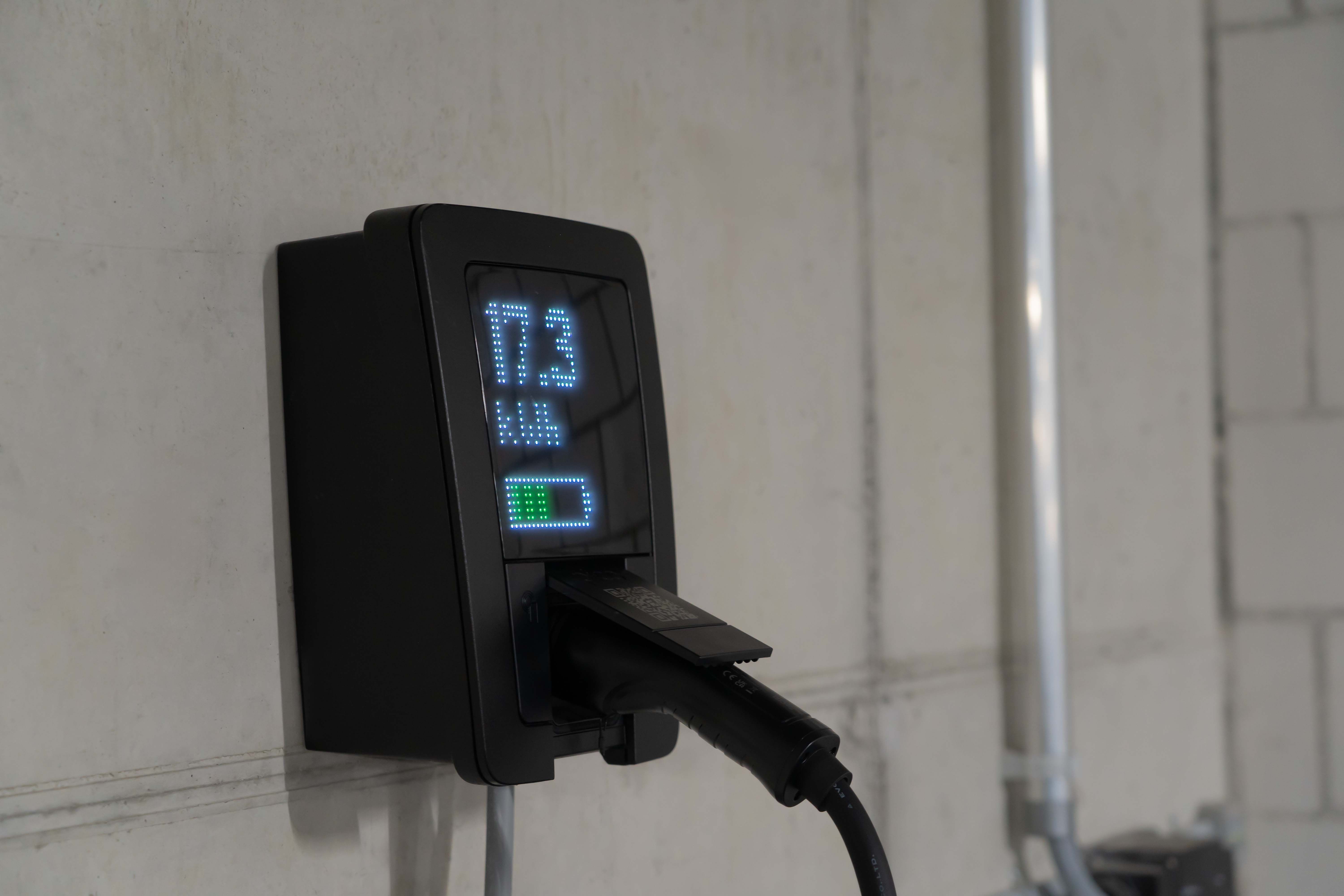
What solution for a home with electric heating?
With 6 or 9 kVA, preserving the available margin
In an electrically heated home, the power demand varies greatly depending on the season and the time of day. Charging started in the evening may overlap with a radiator, a hot water tank, a hob, or a tumble dryer. In this context, scheduling alone may be sufficient if usage is predictable, but it does not protect against all coincidences.Dynamic management becomes particularly relevant when the subscription is limited, when the car is plugged in every day, or when the owner does not want to increase their contract without measuring their actual need. The station then provides the available power, not a fixed power imposed regardless of other consumption.
With 12 kVA or more demanding charging needs
A higher subscription offers extra margin, but it does not automatically resolve issues with the distribution board, cables, protections, or the power actually available at the charging point. For fast charging, multiple vehicles, or intensive daily use, the survey may lead to comparing a power increase, a different supply, current adjustment, or a dedicated installation.In all cases, the useful power also depends on the vehicle's onboard charger and the time the car remains parked. A more powerful station brings no benefit if the car cannot exploit it or if the usage does not require fast charging.
- Simple residential use: prioritise a power level consistent with parking time and charging habits.
- High-demand home: plan for dynamic measurement or a clearly defined shifting strategy.
- Intensive or evolving need: study the subscription, single-phase or three-phase network, the board, and possible extensions before choosing the station.
Meter, subscription, and limits to know
The meter and the subscription are not the same thing as the charging station. The meter measures and limits the delivery point; the provider manages the contract; the installer checks the capacity of the downstream installation and implements the charging solution. A power increase is requested from the provider, who may contact the grid operator if a connection adaptation is necessary.Grid operators also distinguish between connecting a station to the existing installation and creating a charging installation with a new meter. The second option can offer an independent supply, but it involves a new connection and works: it should not be chosen solely to avoid looking at the house's actual usage.
Finally, management does not correct a poorly sized installation. It replaces neither the earth connection, nor a specialized circuit, nor adapted protections, nor the verification of conductor cross-sections and routing. Relevant electrical standards for charging installations and project requirements must be verified by a competent professional.
The method to request before installation
To avoid oversizing the station or suffering power cuts, the survey must start from the house as it is used. Before the quote, prepare the following information:- subscribed power, meter type, and supply type;
- maximum power observed on the meter or customer portal, especially during heating periods;
- appliances likely to operate during charging;
- daily mileage, parking times, and acceptable time to recover range;
- compatibility of the vehicle, the station, and the measurement or management device;
- condition of the board, dedicated circuit, distance to the garage or parking space, and protections to be planned.
You can also compare this approach with our article on choosing the power of a home charging station and with the guide on points to check before installation. If connectivity is considered, the article connected or non-connected station helps distinguish truly useful functions.
In summary
Load shedding for a home charging station serves to avoid exceeding available power, but it has a simple trade-off: when other uses take priority, charging slows down or pauses. For a house with electric heating, dynamic management is a particularly consistent path when the subscription is limited or consumption varies greatly.The final choice must, however, be confirmed by a survey of the installation, meter, vehicle, and household habits. To have a home charging project examined, you can contact MGTEC and request an analysis tailored to your situation.