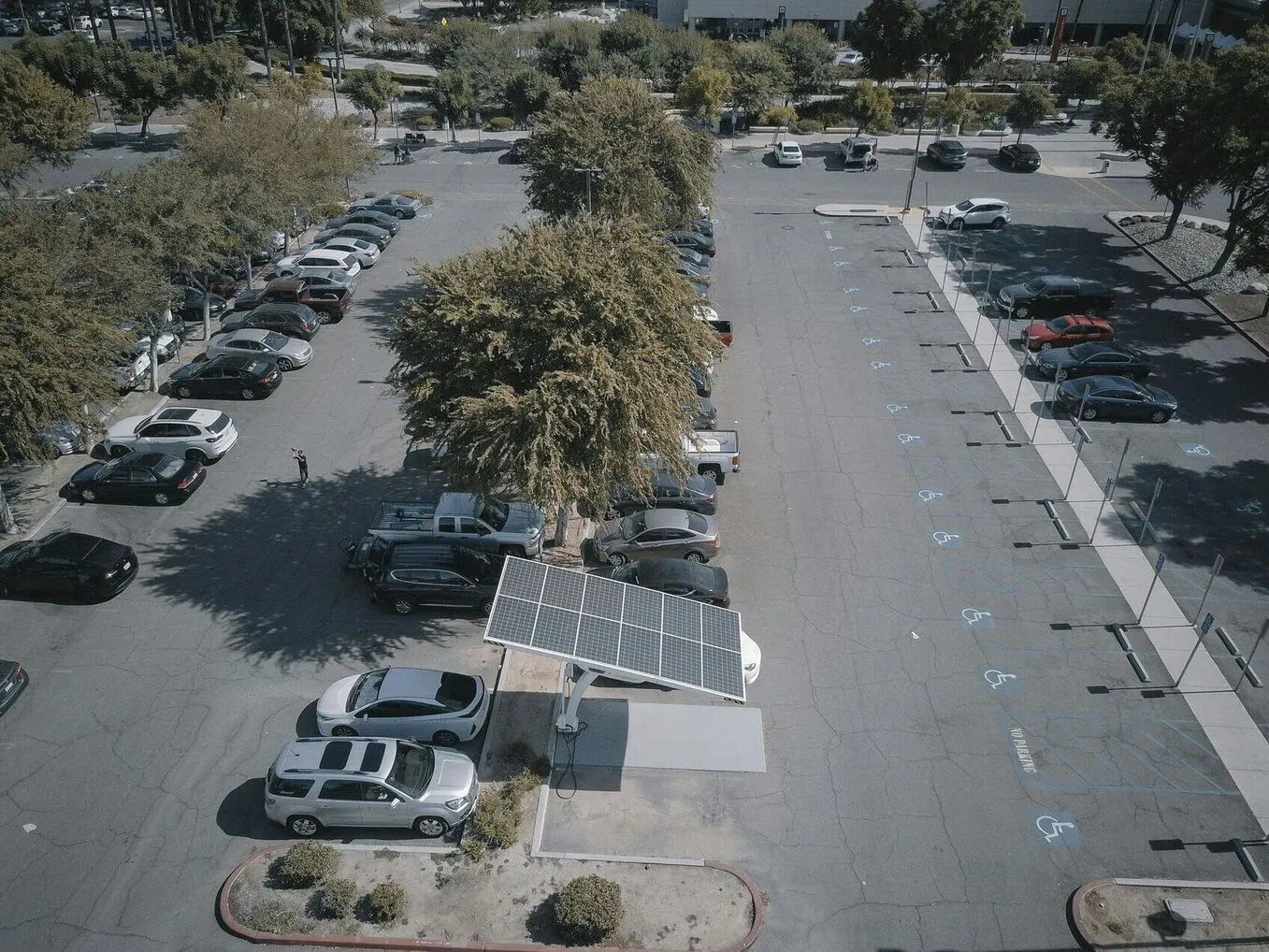
An EV charging car park should be planned as an operational tool
Installing workplace charging points is not simply a matter of fitting a few chargers. The car park becomes an operational space: employees, fleet vehicles, visitors, service vehicles, available power, monitoring, maintenance and future expansion must all be anticipated.At MGTEC, we approach a workplace EV charging project with a site-wide perspective: real usage, electrical constraints, regulatory requirements, safety and the ability to scale without starting again in two years.
Regulatory requirements to understand
Since 1 January 2025, non-residential buildings with a car park of more than 20 spaces must provide at least one charging point accessible to people with reduced mobility. The rule then requires one charging point for each additional group of 20 spaces, with certain adaptations possible when the electrical work would be disproportionate.For car parks with at least 50 spaces, an electrical design study is mandatory for EV charging projects. This is not a formality: it assesses power capacity, the grid connection, protection systems and scalability.
MGTEC advice
The right project is not the one that merely meets the minimum requirement. It is the one that remains practical as the number of electric vehicles increases.
The right project is not the one that merely meets the minimum requirement. It is the one that remains practical as the number of electric vehicles increases.
Start with how the car park will be used
An employee car park, a visitor car park and a fleet of service vehicles are not managed in the same way. Vehicles parked throughout the day can often use well-sized AC charging. Short turnaround times or operational requirements may justify higher power at selected charging points.- How many vehicles will charge at the same time?
- What is the average parking duration?
- Do some vehicles need priority?
- Will charging be free, billed back or restricted to specific user profiles?
Load management is the key to a sustainable car park
Load management prevents every charger from drawing maximum power at the same time. It helps optimise the electricity contract, prioritise certain uses and avoid unnecessary infrastructure upgrades.Monitoring also provides an operational overview: availability, charging sessions, consumption, faults, maintenance and reporting. This information quickly becomes essential for a business.
Plan for expansion from the first installation
A common mistake is to install only what is needed immediately, without spare capacity, planned cable routes or a clear architecture. When the fleet grows, the second phase then costs far more than necessary.A future-ready car park should anticipate conduits, protection systems, metering, future spaces, monitoring and maintenance. This does not mean installing everything immediately, but it does mean building a sound foundation.
Grants and funding: check the exact scope
Some support schemes may apply to workplace EV charging projects, but professional eligibility criteria vary according to the type of site, beneficiary and use. Eligibility must therefore be checked at the quotation stage, and no funding amount should be promised without an assessment.MGTEC can help define the technical solution so that the application is coherent before the available support schemes are considered.